manual greens mower
Manual reel mowers offer a quiet, eco-friendly way to maintain lawns, especially smaller ones, providing a clean cut akin to scissors – a truly classic approach.
What is a Manual Reel Mower?
A manual reel mower, at its core, is a remarkably simple machine. Unlike gasoline or electric powered mowers, it relies entirely on human power to operate. The cutting mechanism consists of a cylindrical reel of blades that spins vertically as the mower is pushed forward. These rotating blades work in conjunction with a stationary bedknife, creating a scissor-like cutting action against the grass.
These mowers are particularly well-suited for smaller lawns – those easily contained within the size of a tennis court – where the convenience of a gas or electric mower isn’t as crucial. They are lauded for their quiet operation, allowing for mowing at any hour without disturbing neighbors, and for their environmentally friendly nature, producing zero emissions. The simplicity of the design also translates to lower maintenance requirements and costs.
Benefits of Using a Manual Reel Mower
Choosing a manual reel mower presents a multitude of advantages. Firstly, they are significantly lighter than their gas or electric counterparts, making them easier to maneuver, especially on hilly terrain. This reduced weight also contributes to increased safety during operation. Beyond physical ease, reel mowers are remarkably cost-effective; eliminating fuel costs and reducing maintenance needs translates to long-term savings.
Environmentally, they are a superior choice, producing zero emissions and minimizing your carbon footprint. The quiet operation is a significant benefit, allowing for mowing without disturbing neighbors or wildlife. Furthermore, the clean, scissor-like cut promotes healthier grass growth, and the convenience factor is high for those with smaller lawns.

History and Evolution of Manual Mowers
Early lawn care relied on scythes and shears, evolving into mechanical mowers in the 19th century, with horse-drawn versions increasing efficiency and scale.
Early Origins: Pre-Mechanical Lawn Care
Before the advent of mechanical lawn mowers, maintaining a respectable lawn was a labor-intensive undertaking. The primary tools employed were decidedly manual – scythes, sickles, and shears. These implements demanded significant physical exertion and skill to achieve a somewhat even cut. Landowners, and those employing gardeners, relied heavily on these methods for centuries.
Keeping grass at a desirable length wasn’t necessarily a widespread practice either. Historically, closely cropped lawns were a status symbol, indicative of wealth and the ability to dedicate resources to their upkeep. Grazing animals, like sheep, were also commonly used to naturally “mow” larger areas, offering a more sustainable, though less precise, solution. The pursuit of a perfectly manicured lawn, as we know it today, was a relatively late development, spurred by changing social ideals and the eventual invention of more efficient mowing technologies.

The Invention of the Reel Mower
Edwin Budding’s 1830 patent marked a pivotal moment in lawn care history – the invention of the reel mower. Budding, an engineer at Stroud Iron Works, conceived the idea while working on cloth-cutting machinery. He adapted the principle of rotating blades to cleanly cut grass, offering a significant improvement over previous methods.
His initial design featured a rear roller to smooth the cut and a blade cylinder comprised of helical blades rotating against a fixed blade. This “scissor-like” action provided a more uniform and efficient cut. Early models were primarily marketed to sports grounds and large estates, as they were still relatively expensive and required manual pushing. However, Budding’s invention laid the foundation for the modern lawn mower, revolutionizing how we maintain our green spaces.
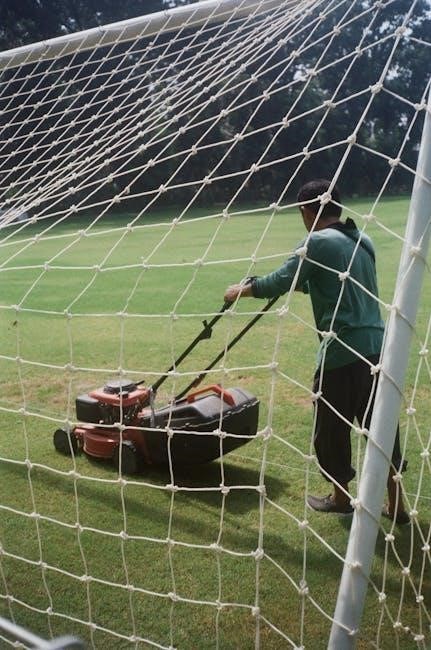
Horse-Drawn Mowers: A Step Up in Scale
By the late 1800s, the demand for efficient lawn maintenance on larger properties spurred the development of horse-drawn mowers. These machines represented a significant leap in scale and capability compared to earlier, manually-propelled reel mowers. Essentially, they were larger, more robust versions of the original design, adapted to be pulled by horses.
This innovation allowed for considerably faster mowing of expansive estates and public parks. The core cutting mechanism remained the same – a rotating reel of blades working against a fixed bedknife – but the horse provided the necessary power to cover greater areas. While still relying on the principles of the reel mower, these horse-drawn models addressed the limitations of manual labor, making large-scale lawn care more practical.

How Manual Reel Mowers Work
Reel mowers utilize a scissor-like action, with a rotating reel of blades and a stationary bedknife precisely cutting grass with each revolution.
Understanding the Reel and Bedknife
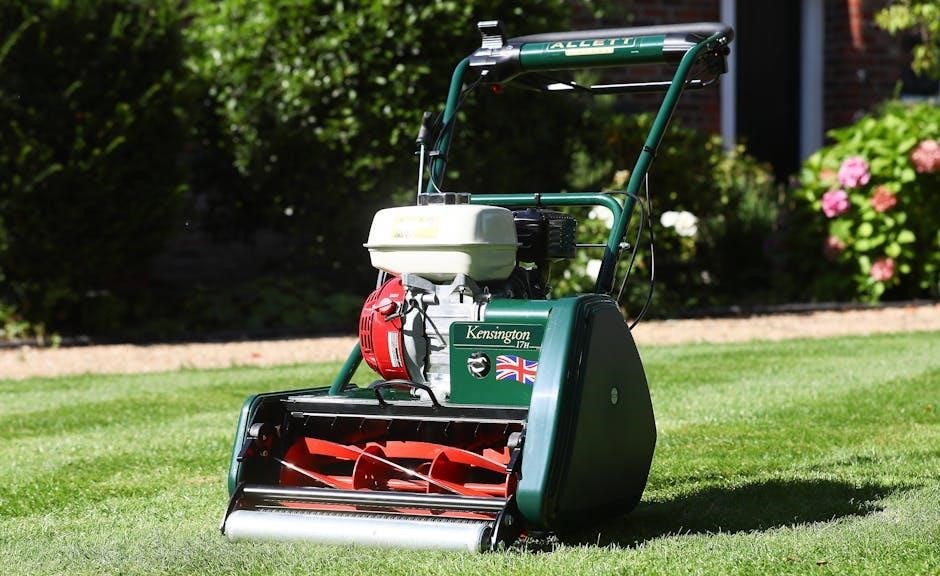
The reel, composed of multiple curved blades, spins vertically when the mower is pushed forward, functioning much like a cylindrical scissor. These blades are meticulously crafted to ensure a clean and precise cut with each rotation. The bedknife, a stationary blade positioned just below the reel, acts as the lower blade of the scissors.
Its sharpness and precise alignment with the reel are absolutely critical for achieving a quality cut. Any misalignment or dullness will result in tearing the grass instead of cleanly slicing it. The interaction between the rotating reel blades and the fixed bedknife is the core principle behind the mower’s effective cutting action. Maintaining both components is essential for optimal performance and a healthy lawn.
The Cutting Action: A Scissor-Like Mechanism
Manual reel mowers employ a remarkably simple yet effective cutting action, directly mimicking the motion of a pair of scissors. As the mower moves forward, the reel spins, and each blade passes the fixed bedknife in a shearing action. This precise, clean cut avoids ripping or tearing the grass blades, promoting healthier growth and a more vibrant lawn.

Unlike rotary mowers that chop the grass, reel mowers slice it, resulting in a neater appearance and reduced stress on the plant. The quality of this scissor-like action is heavily dependent on the sharpness of both the reel blades and the bedknife, demanding regular maintenance for peak performance. This method is ideal for those seeking a pristine, manicured lawn.
Adjusting the Cutting Height
Manual reel mowers offer adjustable cutting heights, typically controlled by raising or lowering the mower’s chassis relative to the reel. This adjustment is crucial for achieving the desired lawn appearance and adapting to varying grass types and conditions. Many models feature a simple lever or dial system for easy height selection, allowing users to quickly switch between settings.
Lower settings promote a finer cut, ideal for achieving a golf-course-like finish, while higher settings are better suited for longer grasses or uneven terrain. Proper height adjustment is vital for healthy lawn maintenance, preventing scalping and ensuring consistent results. Regularly adjusting the height based on growth patterns is recommended.

Using a Manual Reel Mower: Best Practices
Optimal mowing requires a prepared lawn and consistent patterns, ensuring a clean, scissor-like cut for a healthy and beautifully maintained green space.
Preparing Your Lawn for Mowing
Before operating a manual reel mower, proper lawn preparation is crucial for achieving the best results and ensuring a smooth, effortless mowing experience. Begin by thoroughly removing any debris from the lawn – sticks, stones, toys, or any other objects that could obstruct the mower’s path or potentially damage the blades.
Next, ensure the grass isn’t excessively wet. While reel mowers excel at cutting dry grass, attempting to mow when it’s soaked can lead to clumping and an uneven cut. A slightly damp lawn is acceptable, but avoid mowing immediately after rainfall or heavy watering. Finally, consider the grass height; if it’s significantly overgrown, it’s best to raise the mower’s cutting height for the initial pass and gradually lower it with subsequent passes to avoid straining the mower and achieve a cleaner cut.
Optimal Mowing Techniques
To maximize the effectiveness of your manual reel mower, employ specific techniques. Walk at a consistent, moderate pace – not too fast, as this can compromise the cut quality. Overlap each mowing pass slightly, typically by a few inches, to prevent scalping and ensure complete coverage;
Maintain a straight, even path, utilizing the mower’s wheels as a guide. For thicker or taller grass, reduce your walking speed and consider making multiple passes, gradually lowering the cutting height with each pass. Avoid sharp turns, as these can be difficult to maneuver with a reel mower and may result in an uneven cut. Remember, a slower, deliberate approach yields the best results with this type of mower.
Maintaining a Consistent Mowing Pattern
Establishing a regular mowing pattern is crucial for a healthy, visually appealing lawn. Alternate your mowing direction with each cut – for example, mow north-south one week, then east-west the next. This prevents the grass from leaning in one direction, promoting upright growth and a more uniform appearance.
Avoid repeatedly mowing in the same pattern, as this can compact the soil and create ruts. Consider a diagonal pattern for varied results. Consistent patterns also help you identify any areas that may be missed during mowing, ensuring complete coverage. A well-planned pattern contributes to a professionally maintained lawn aesthetic.

Maintenance and Care
Regular maintenance, including sharpening the reel and bedknife, alongside cleaning and proper storage, ensures optimal performance and extends the lifespan of your mower.
Sharpening the Reel and Bedknife
Maintaining a sharp cutting edge on both the reel and bedknife is paramount for a clean, precise cut and the overall health of your lawn. Dull blades tear the grass, leading to browning and increased susceptibility to disease. Sharpening frequency depends on usage, but generally, annual sharpening is recommended for recreational use, while more frequent attention is needed for intensive mowing.
Several methods exist for sharpening. You can utilize a specialized sharpening tool designed for reel mowers, or carefully employ a fine file. Ensuring the correct angle is crucial; typically, the reel blades are sharpened to a slightly steeper angle than the bedknife. Professional sharpening services are also available, offering convenience and expertise. After sharpening, always check for proper alignment to guarantee a scissor-like action.
Cleaning and Lubrication
Regular cleaning and lubrication are vital for preserving the functionality and longevity of your manual reel mower. After each use, remove grass clippings from the reel and bedknife assembly to prevent buildup and corrosion. A stiff brush works effectively for this purpose. Pay particular attention to areas where grass tends to accumulate, such as around the axles and bearings.
Following cleaning, apply a light oil to all moving parts, including the reel bearings, wheel axles, and any pivot points. This reduces friction, ensuring smooth operation and preventing rust. Avoid over-lubrication, as excess oil can attract dirt and debris. Choose a lubricant specifically designed for lawnmower maintenance. Proper care ensures effortless mowing for years to come.
Storage Considerations
Proper storage significantly extends the life of your manual reel mower. Before long-term storage, thoroughly clean the mower, removing all grass clippings and debris as previously described. Apply a light coat of oil to prevent rust formation on metal parts, especially during humid seasons. Store the mower in a dry, sheltered location, such as a garage, shed, or basement.
Avoid storing it outdoors, exposed to the elements. If space is limited, consider hanging the mower to save floor space. Protect it from extreme temperatures and direct sunlight. Regularly check the mower during storage and re-oil as needed. Careful storage ensures it’s ready for use when the mowing season returns, maintaining optimal performance.

Manual Mowers vs. Gas/Electric Mowers
Compared to powered mowers, manual reel mowers are quieter, cheaper to operate, and lighter, making them ideal for smaller lawns and hilly terrains.
Cost Comparison
Initial investment for a manual reel mower is significantly lower than gas or electric alternatives. While a basic gas mower can easily cost several hundred dollars, and electric models aren’t far behind, a quality manual reel mower often falls within the $100-$300 range. However, the long-term cost differences are even more striking.
Gas mowers require ongoing expenses like gasoline, oil, spark plugs, and potential repair costs. Electric mowers necessitate electricity usage and battery replacements over time. Manual reel mowers, conversely, have minimal running costs – primarily the occasional sharpening of the blades. This simplicity translates to substantial savings over the mower’s lifespan, making them a financially sensible choice for many homeowners, particularly those with smaller lawns.
Environmental Impact
Manual reel mowers represent a significantly more environmentally friendly option compared to their gas-powered or electric counterparts. Gas mowers release harmful emissions, contributing to air pollution and greenhouse gases. Electric mowers, while emission-free during operation, rely on electricity generation, which often involves fossil fuels.
Reel mowers, powered solely by human effort, produce zero emissions. They also eliminate the noise pollution associated with motorized mowers, creating a quieter and more peaceful gardening experience. Furthermore, the absence of oil and gasoline reduces the risk of spills and soil contamination. Choosing a manual reel mower is a tangible step towards sustainable lawn care and a reduced carbon footprint, benefiting both the environment and your well-being.
Noise Levels and Convenience
A key advantage of manual reel mowers is their remarkably quiet operation. Unlike the roaring engines of gas mowers or the buzzing of electric models, reel mowers operate silently, allowing you to mow at any hour without disturbing neighbors. This is particularly appealing for those living in close proximity to others or seeking a peaceful gardening experience.
While requiring physical effort, reel mowers offer surprising convenience for smaller lawns. Their lightweight design makes them easy to maneuver, even on hilly terrain. The elimination of fuel or cords simplifies operation and storage. You can mow at the crack of dawn without complaints, enjoying the bird song instead! For appropriately sized lawns, they are a convenient and satisfying alternative.